
Rehabilitation & Sports
Wheelchair Basketball Builds Community at California Medical Facility
Created by recreation supervisor Jeremiah Holland and coached by Mieko and Joe Chambers, the program aligns with California’s new Second Chance Sports Act.
Your listening Queue & catch up
Add a story or build a catch-up queue to start listening.
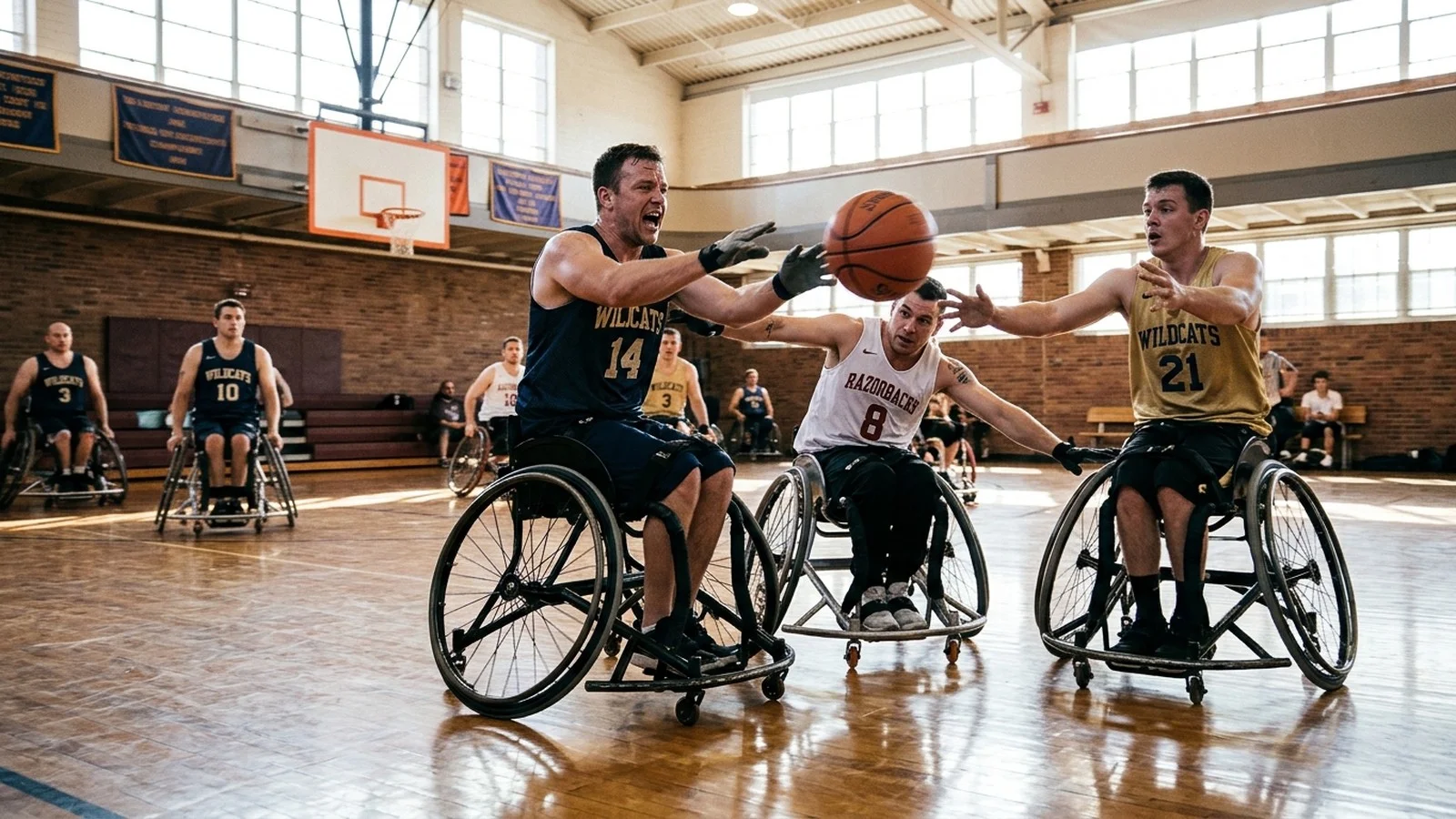
Inside the gymnasium at the California Medical Facility—a state prison located about 55 miles northeast of San Francisco—a wheelchair basketball program launched publicly in late 2022 is uniting incarcerated men with physical disabilities and able-bodied teammates to build character, accountability, and community, according to a CalMatters report published by The Almanac.
With the words “RE CREATION” painted in black on the gymnasium wall, the program was created by Jeremiah Holland, who served as the facility’s recreation supervisor until September. At least 15 players and five coaches gather for Wednesday afternoon practices, beginning in a circle where players share news, welcome newcomers, and recite their team slogan: “Everything we do, we do together.”
Paralympic Coaching and Peer Accountability
The team is led by outside volunteer head coach Mieko Chambers—who also serves as head coach of the Los Angeles Clippers Chairmen in the National Wheelchair Basketball Association and won a 2019 gold medal as an assistant coach for Team USA’s women’s U25 wheelchair team—and her husband, two-time Team USA Paralympian bronze medalist Joe Chambers.
Allowing able-bodied players to train in slanted-wheel sports chairs alongside teammates who use wheelchairs every day was an intentional design choice.
“All of a sudden, there’s this newfound respect for somebody that is looked to be weak or hurt,” Mieko Chambers said.
Inside the facility, players such as co-captains Quentin Murphy and Steven Davis helped anchor the team’s culture of mutual support, alongside able-bodied “inside” coach Larry Roach and former player Landon Jackson. Jackson was released in 2024 after Holland submitted his name for resentencing with a letter of support from the warden, and Roach was released in mid-October 2026 after more than two decades in custody.
From the Facility Gym to the National Wheelchair Basketball Association
Coaches point to former player Lavonte McDowell as a model of the program’s rehabilitative reach. After joining the California Medical Facility team and becoming a peer leader, McDowell was invited in the fall of 2024 to play for the Los Angeles Clippers Chairmen following his release in early November 2024. He competed with the Chairmen during the 2025–26 season and now works with Project Rebound, an organization that connects formerly incarcerated people with higher education.
The program’s growth comes as California expands prison athletics statewide: on Sept. 30, 2026, Gov. Gavin Newsom signed the Second Chance Sports Act, directing the state’s prison system to develop a plan to expand organized sports programming through which participants can earn credits toward early release.
The team has already played a handful of games against outside visitors, including a Berkeley-based adaptive sports organization, and the coaches hope to eventually register the California Medical Facility squad with the National Wheelchair Basketball Association to host sanctioned games inside the gym.
Sources
Comments (0)
No comments yet. Be the first to share a thought on this story.