
Policing & Privacy
UC Berkeley Study Questions Police Drone Claims as Hearings Heat Up
Required public hearings under a 2021 California military-equipment law have sparked fierce debate in Berkeley, San Francisco, and Stockton.
Your listening Queue & catch up
Add a story or build a catch-up queue to start listening.
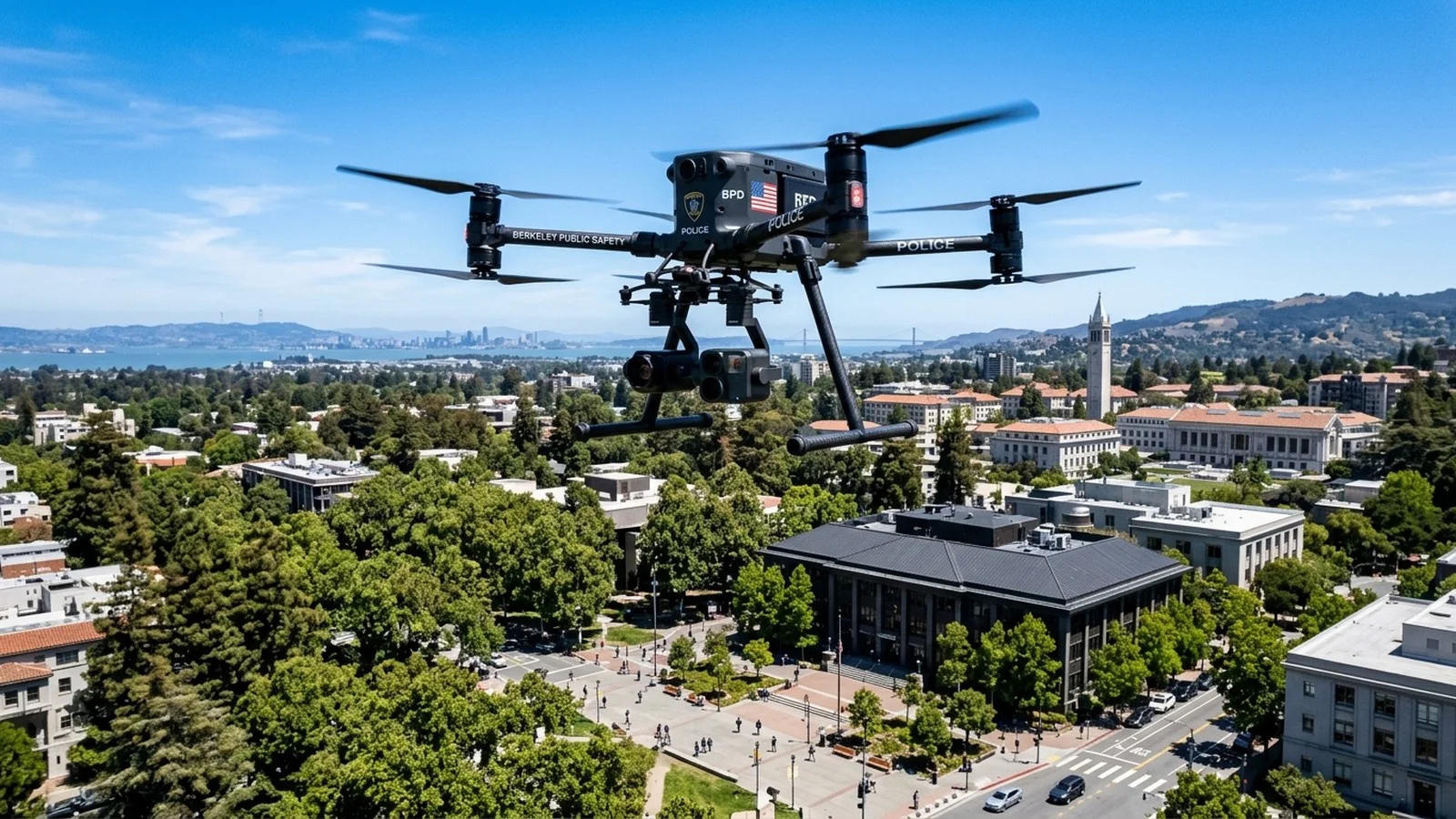
As nearly 60 California law enforcement agencies operate unmanned aircraft programs and cities including Berkeley, San Francisco, Stockton, and Santa Ana debate expanding “Drone as First Responder” deployments, a February 2026 study by the UC Berkeley Criminal Law and Justice Center found that while first-responder drones can shorten response times, there is no evidence they reduce officer-involved shootings, lower overall use of force, or improve case resolution rates, according to a CalMatters report published by The Almanac and Mountain View Voice.
Under California’s 2021 Assembly Bill 481—which requires explicit local governing board approvals and public hearings for law enforcement “military equipment,” including drones—routine municipal policy reviews have increasingly turned into crowded battles over Fourth Amendment privacy boundaries.
San Francisco Police Commission Vote and Warrant Debate
Earlier this month in San Francisco, a packed Police Commission hearing debated a San Francisco Police Department proposal allowing drones for public safety response, active investigations, training, and community outreach, with public footage retained for 30 days unless tied to an open investigation.
While Anna Carney, president of Stop Crime SF, urged commissioners to approve the policy so officers have “every responsible advantage to save lives,” DeFlock SF member Manny called on commissioners to cancel the department’s contract with San Mateo-based manufacturer Skydio or add a warrant requirement. Retired police commissioner Jesus Gabriel Yanez also opposed routine patrol use, stating that deployments should be tied strictly to specific incidents involving officer safety. Commissioners voted to advance the policy to labor negotiations without adding a warrant mandate.
Multimillion-Dollar Vendor Contracts and Constitutional Gray Areas
The statewide expansion includes Stockton’s $3.15 million contract expansion with Flock Safety to integrate six drones into its 120 license-plate-reader cameras, Santa Ana’s $682,900 Drone as First Responder partnership with Skydio, and a $9.4 million donation to SFPD last year from Ripple co-founder Chris Larsen. Drone policy expert Katie Inman of Holland & Knight noted that California lacks a comprehensive state statute explicitly governing police drone surveillance, leaving cities to navigate Fourth Amendment case law on their own.
Sources
Comments (0)
No comments yet. Be the first to share a thought on this story.